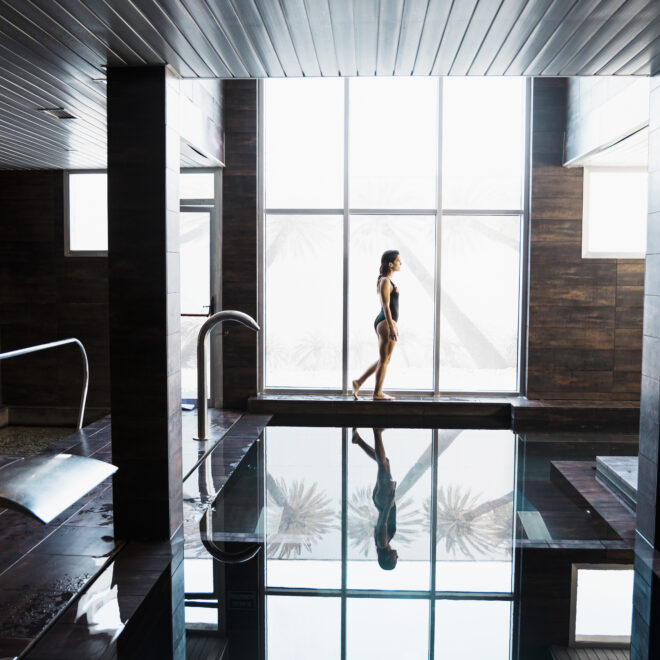
Swimming pool ventilation

Dizajn bez nazvu

Fresh air in, moisture out. DRY AirX dries pool spaces through ventilation—not refrigerant recirculation. Its X-flow heat exchanger crosses airstreams to reclaim heat efficiently, delivering clean, comfortable air with lower running costs than compressor units. Humidity under control while keeping the heat. Works for any pool size—new builds or retrofits in existing/older pools—with resistance to aggressive environments: chlorine, salt, UV and electrolysis pools are a perfect match.

What is AirX technology?

AirX is Microwell’s fresh-air dehumidification platform for swimming pools. Instead of cooling and reheating the same indoor air with a compressor, AirX brings in 100% outdoor air and exhausts humid indoor air. In the X-flow heat exchanger, the two airstreams cross and transfer heat—so supply air is tempered, humidity is exported outside, and indoor air quality improves.

What’s different with AirX

  1. No refrigerant, no compressor - fewer F-gas worries and simpler maintenance.
  2. Ventilation-first dehumidification - exports moisture outdoors instead of condensing it internally.
  3. X-flow heat recovery - optimised cross-flow core for high ηt, with balanced pressure drops; up to ~80–83% in typical profiles (preliminary).
  4. Energy-focused design - EC fans + heat recovery as baseline; optional reheat only in cold scenarios.
  5. Cleaner, fresher air - tackles “pool smell” (chloramines) and brings in oxygen-rich outdoor air.
  6. Maintenance-smart - filter alert, easy access, and no compressor servicing.
  7. Scalable & flexible - from small home spas to large public pools, suitable for new builds and retrofits (COMPACT for quick installs; DUCT for plant-room integration).

No Refrigerant. No Compressor. Just X-Flow.

X-Flow is a new heat-exchange core where supply and extract cross in an “X.” Energy from the warm exhaust is transferred to the incoming fresh air while humidity is carried out of the building. No refrigerant, no compressor—just intelligent ventilation.

DRY AirX models

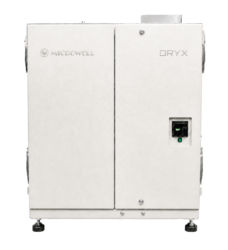
DUCT DRY AirX 1600 ECO, a plant-room solution for larger pool halls delivering fresh-air dehumidification with X-flow heat recovery and low OPEX; DUCT DRY AirX 1600 PRO, the same quiet precision upgraded for aggressive environments with an epoxy-protected aluminium exchanger (ideal for chlorine, salt, UV, electrolysis); and DRY AirX 1200 Pro — COMPACT, a room-mounted model for fast retrofits and boutique spaces, combining low noise with PRO corrosion protection. Final specifications will be revealed at launch—reserve the Project Pack or get notified first.

How it works

Outdoor air enters the unit and passes through the X-flow heat exchanger while humid air from the pool hall is extracted and driven through the exchanger in the opposite direction. As the two airstreams cross, heat transfers from the exhaust to the incoming supply, tempering the fresh air before it enters the space, and the moisture is carried away to the outside with the exhaust stream. In warm seasons a built-in bypass routes air around the exchanger for free-cooling and rapid venting when conditions allow, while an optional recirculation path can be engaged to speed up space reheat after setbacks. In practice, dehumidification scales with the absolute humidity difference multiplied by airflow, so your selected design flow determines the achievable litres-per-day at the target temperature and relative humidity.

Installation

Standards for Designers

Scope. This guidance helps you design with DRY AirX in projects following ASHRAE natatorium best practice and VDI 2089 (Indoor swimming pools — ventilation & dehumidification). Use alongside national/local codes, fire regulations, and architectural envelope requirements.

Dizajn bez nazvu 1

Technical Data

PV Ready Mail Chimp

Frequently searched phrases

Is DRY AirX suitable for small pools and large public pools?

Yes. AirX scales from compact home spas to large commercial pools, in both new builds and retrofits.

Does AirX use refrigerant or a compressor?

No—AirX is a fresh-air, ventilation-based dehumidifier (no refrigerant).

How does AirX reduce running costs?

By combining X-flow heat recovery (reclaiming heat from exhaust air) with low-power EC fans and on-demand reheat only in cold conditions.

Can it connect to BMS?

Yes—BACnet/Modbus options are available on request.

What filters are available?

Panel filters (standard) and bag filters (optional) for lower pressure drop and longer service life. Class as per EN779/EN1822 is available G4 and M5. On demand also F7.

Which technical specs matter most when selecting a DRY AirX?

Focus on thermal efficiency (ηt) of heat recovery, dehumidification capacity in winter and summer profiles (always state the test profile), and—especially for COMPACT units—sound levels. For both COMPACT and DUCT versions, check the heat-exchanger material: DUCT ECO = plastic, DUCT PRO = aluminium epoxy, COMPACT 1200 ORIENT = aluminium epoxy.

How do I choose exchanger material and manage noise?

For aggressive environments (chlorine, salt, UV, electrolysis), select epoxy-coated aluminium (DUCT PRO or COMPACT 1200 ORIENT). For standard conditions, DUCT ECO (plastic) is suitable. In COMPACT installations, prioritize low noise—review the dB(A) at your airflow; for DUCT, final noise depends on fan speed and duct design.

Read more
Request a Quote

Microwell requests your consent to store cookies on your device for the following uses:

Some personal data will be processed from your device (cookies, unique identifiers and other devices) and may be shared with third party providers, and used by this website or application. Some third party suppliers may use these date accoring to legitimate interest, which you can object to using the options bellow. Your consent can be canceled anytime using the icon below.

Technical cookies

These cookies are necessary, they contain anonymous data to match your browser to your session.

Analytical Cookies

We use Google Analytics to improve our website and services, which receives anonymous, aggregated data about the habbits of our visitors.